

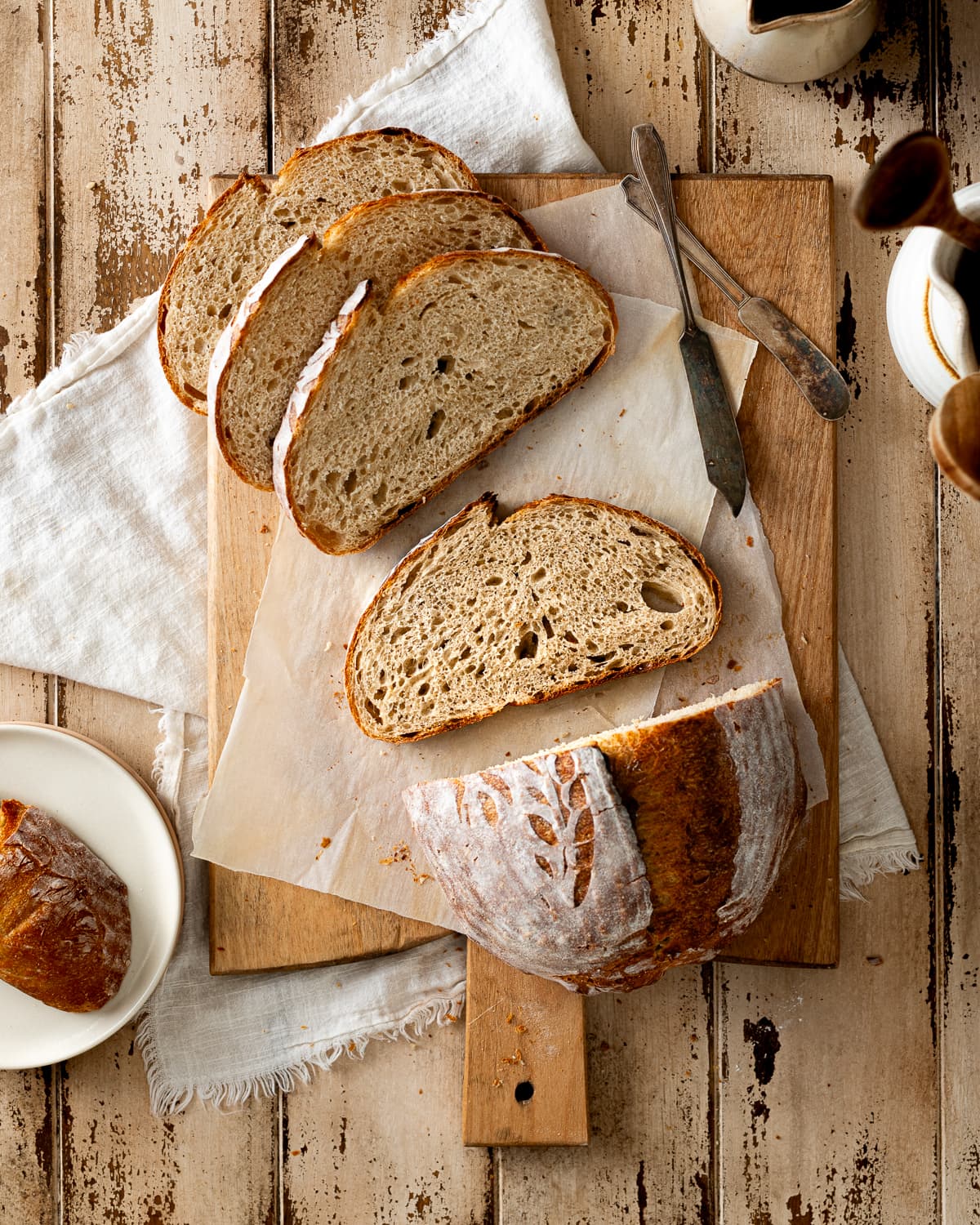
If you're craving fresh-baked bread but didn't plan ahead, this no-knead discard bread fits easily into a busy schedule. It's mixed by hand, rises quickly, and bakes into a loaf that's light, soft, and full of tangy flavor. You don't even need to activate your sourdough starter! This is the recipe I rely on when I want a light, flavorful loaf but don't have the time (or energy) to make my classic sourdough bread recipe. Everything comes together in one bowl with a few simple ingredients, making fresh bread feel doable on any day of the week.
This recipe was originally published in Sept. 2023. I have since added more photos and tips for success.
5-STAR REVIEW
This was my first run through with this recipe and it turned out amazing! I love that this loaf yields a similar structure to a true sourdough loaf with a fraction of the time and effort. Will definitely make again.
Allison
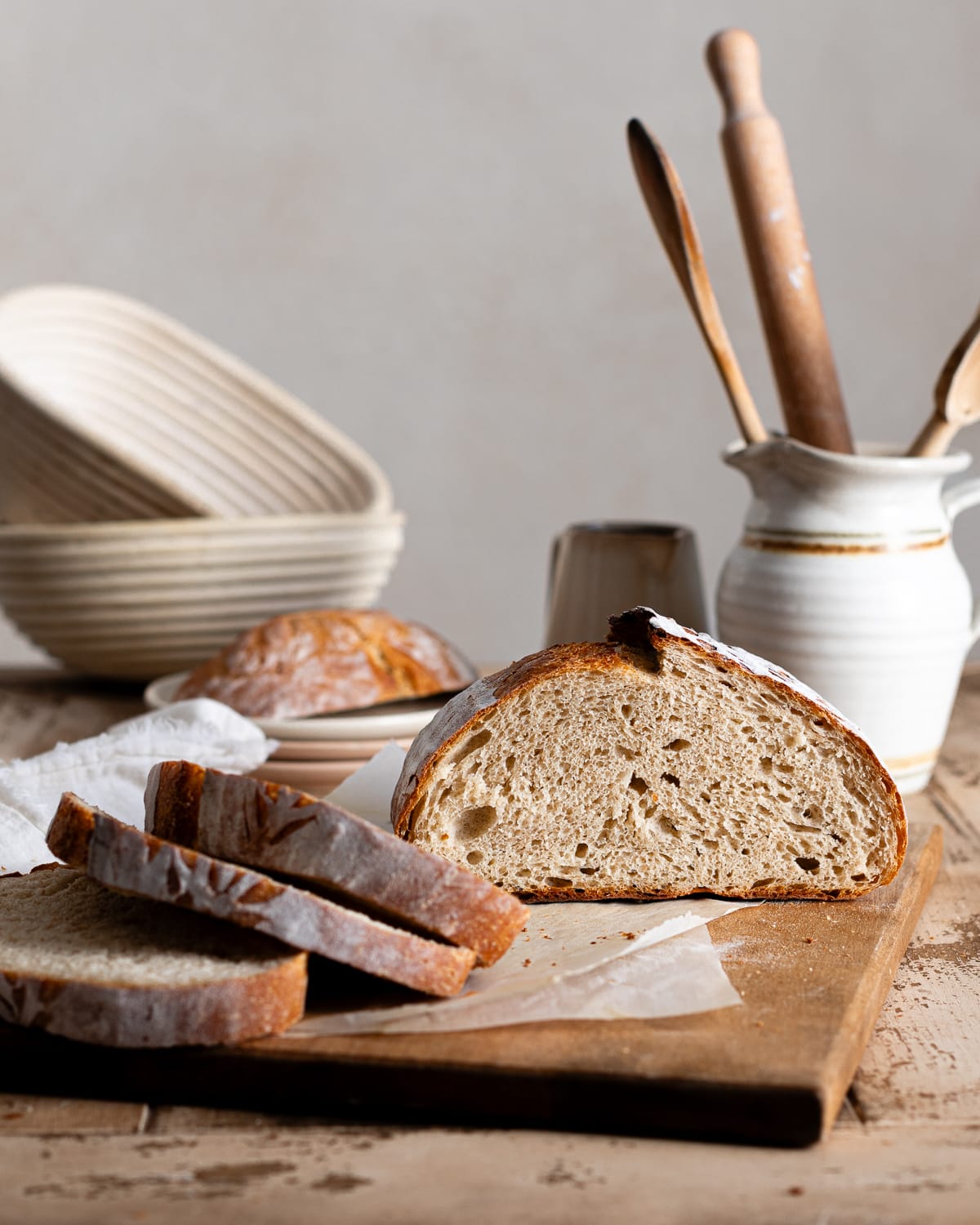
I'll admit, I used to be a bit of a purist and believed good bread could only come from long fermentation. But as life has gotten fuller (we've added a few pets to our family and I've picked up a few new hobbies), I've embraced how reliable and convenient baking with commercial yeast can be. Paired with sourdough discard, it still makes wonderfully flavorful bread, just on a schedule that fits real life.
If you've made my sourdough discard focaccia, sourdough discard pretzels, and sourdough discard sandwich bread, you'll know that sourdough discard and a bit of yeast can work together beautifully.
Ingredients and Substitutions
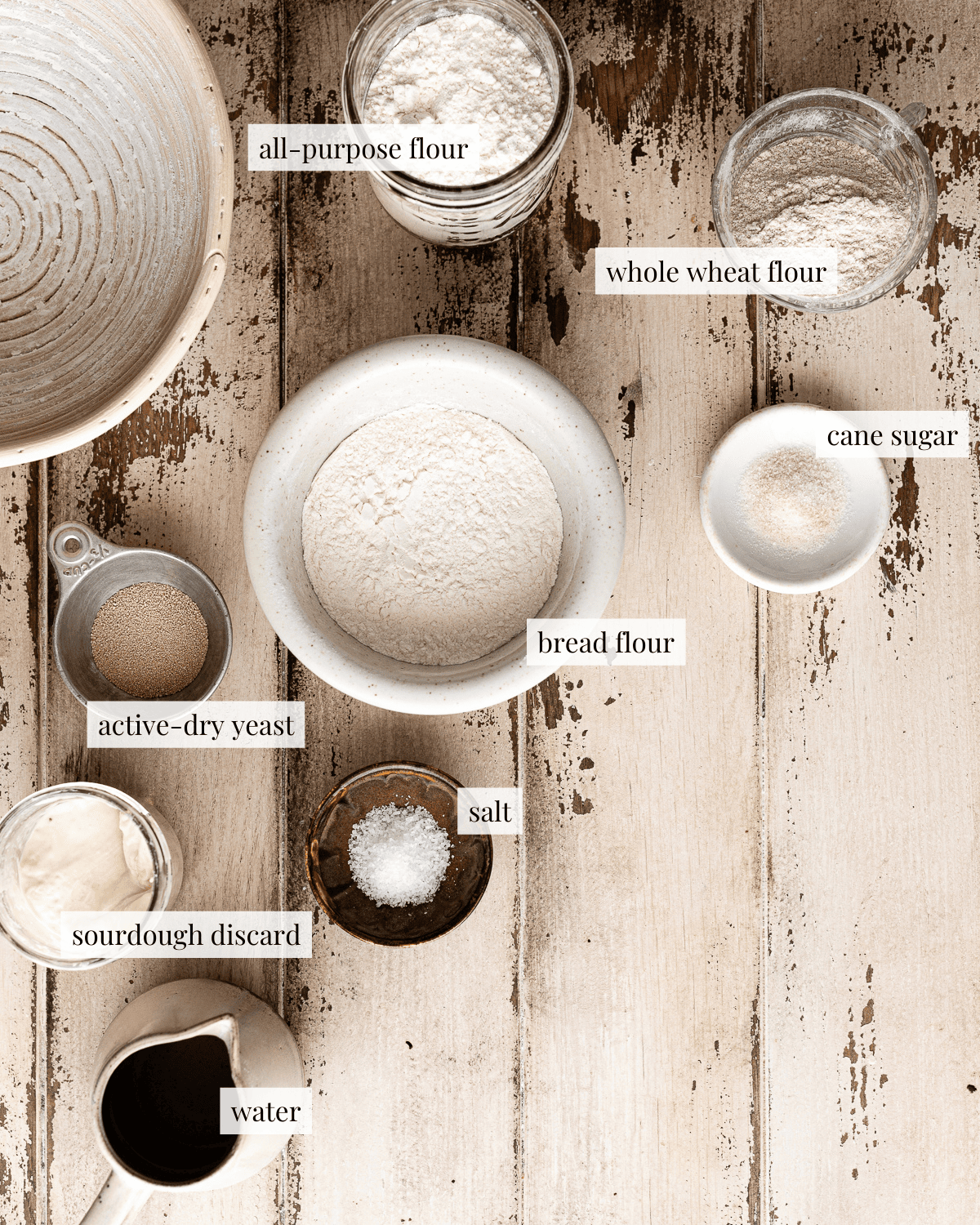
This recipe uses a mix of different types of flours, all-purpose flour, bread flour and whole wheat the ideal mix for flavor and texture. But if you don't have all three on hand, no problem. You can use just all-purpose or bread flour and still get great results.
Since this recipe uses commercial yeast you can use your sourdough starter straight from the fridge, no need to activate it!
Step-by-step Instructions
STEP 1: Make the dough
Combine water, sugar and active-dry yeast, let the yeast bloom for 15 minutes. Add in the sourdough starter and dry ingredients. Mix until no traces of dry flour remain.

STEP 2: Stretch and fold
Perform 3 sets of stretch and folds in 15-minute intervals during bulk rise. To perform 1 set, use your fingertips pick up one side of the dough and stretch it as far as you can without tearing. Then fold the dough over itself, turn the bowl 90 degrees, and repeat 3 more times (this is one set).

Stretch and Fold Sample Schedule
9:00 a.m. - Fold 1
9:15 a.m. - Fold 2
9:30 a.m. - Fold 3
STEP 3: First rise
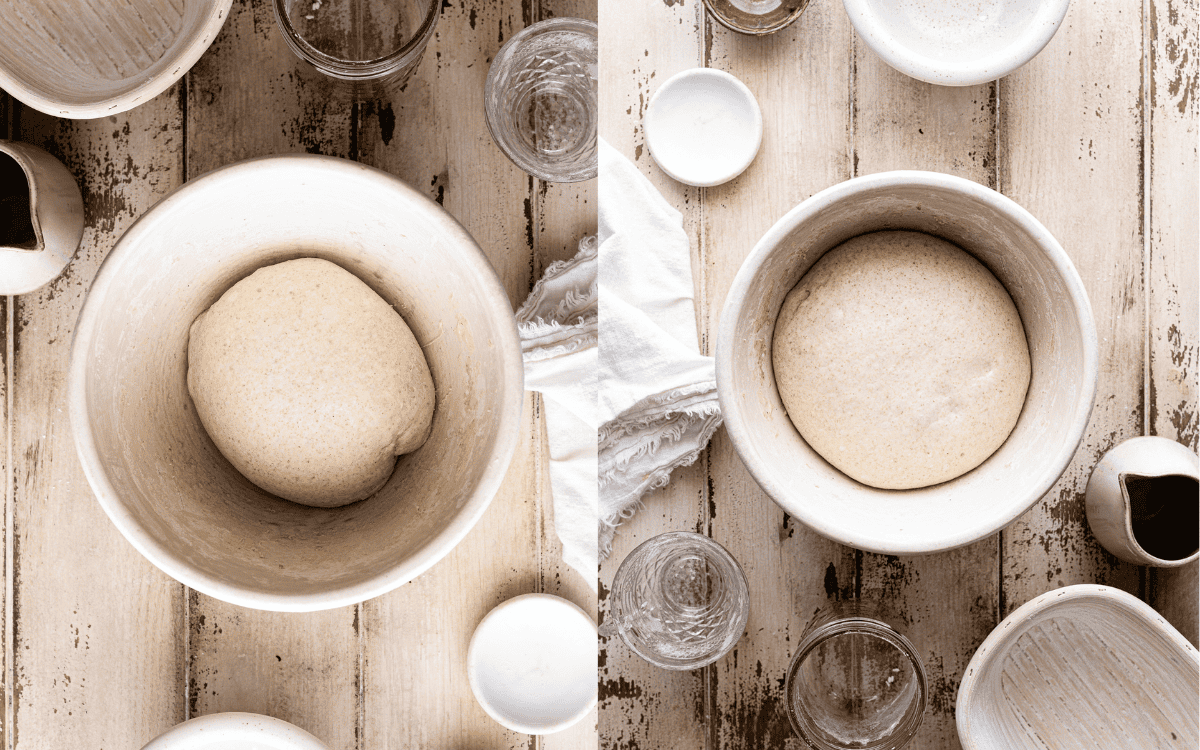
After the last fold, allow the dough to rise untouched until doubled in volume.
STEP 5: Bake
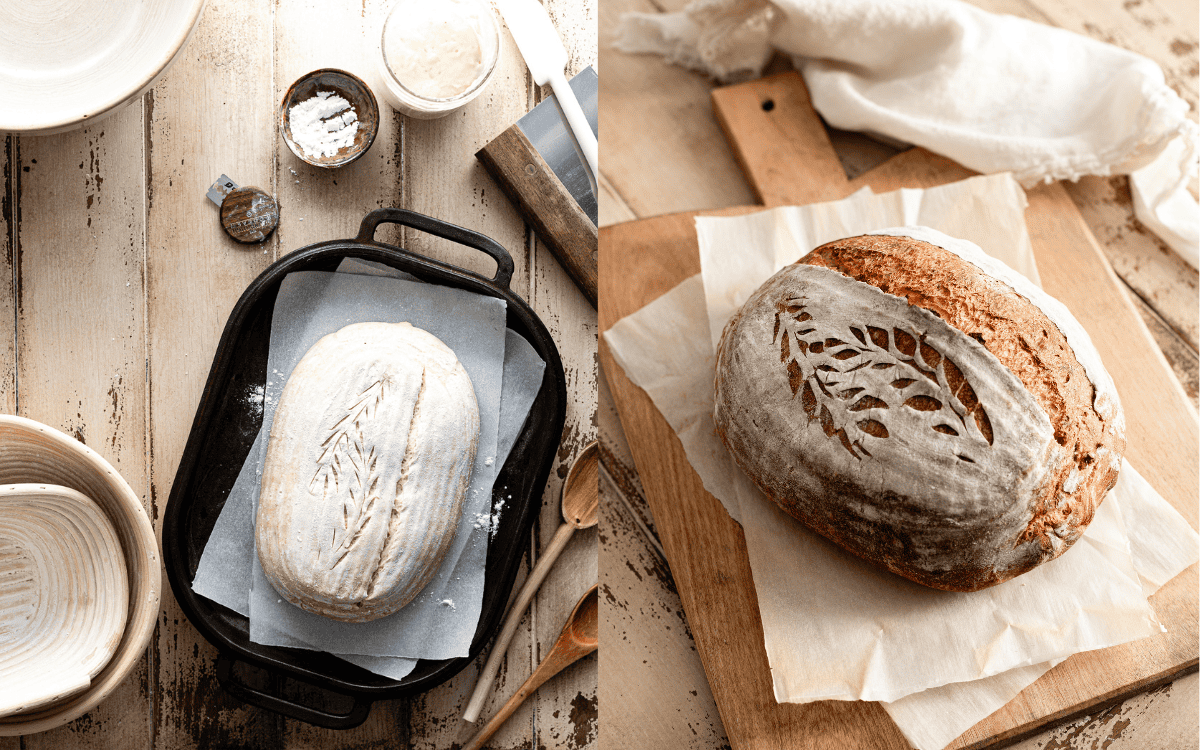
Score the dough. Bake in a covered Dutch oven at 475 F for 25 minutes. Remove the cover and bake at for an additional 10 to 15 minutes, depending on how dark you'd like your crust.
Tips from Hannah's test kitchen
- This dough contains a lot of water (about 73% hydration). It's completely normal for your dough to feel very sticky and difficult to handle right after it's mixed. Don't panic! Be gentle, use your fingertips during stretch and fold, and keep your hands damp to make it easier to handle.
- Although I love how yeast speeds things up, I had better results using cold water during testing. It slows down fermentation, but it gives the dough more time to develop flavor and the payoff is worth it.
- This bread works really well as a sandwich loaf too check out How to Bake Bread in a Loaf Pan in my post.
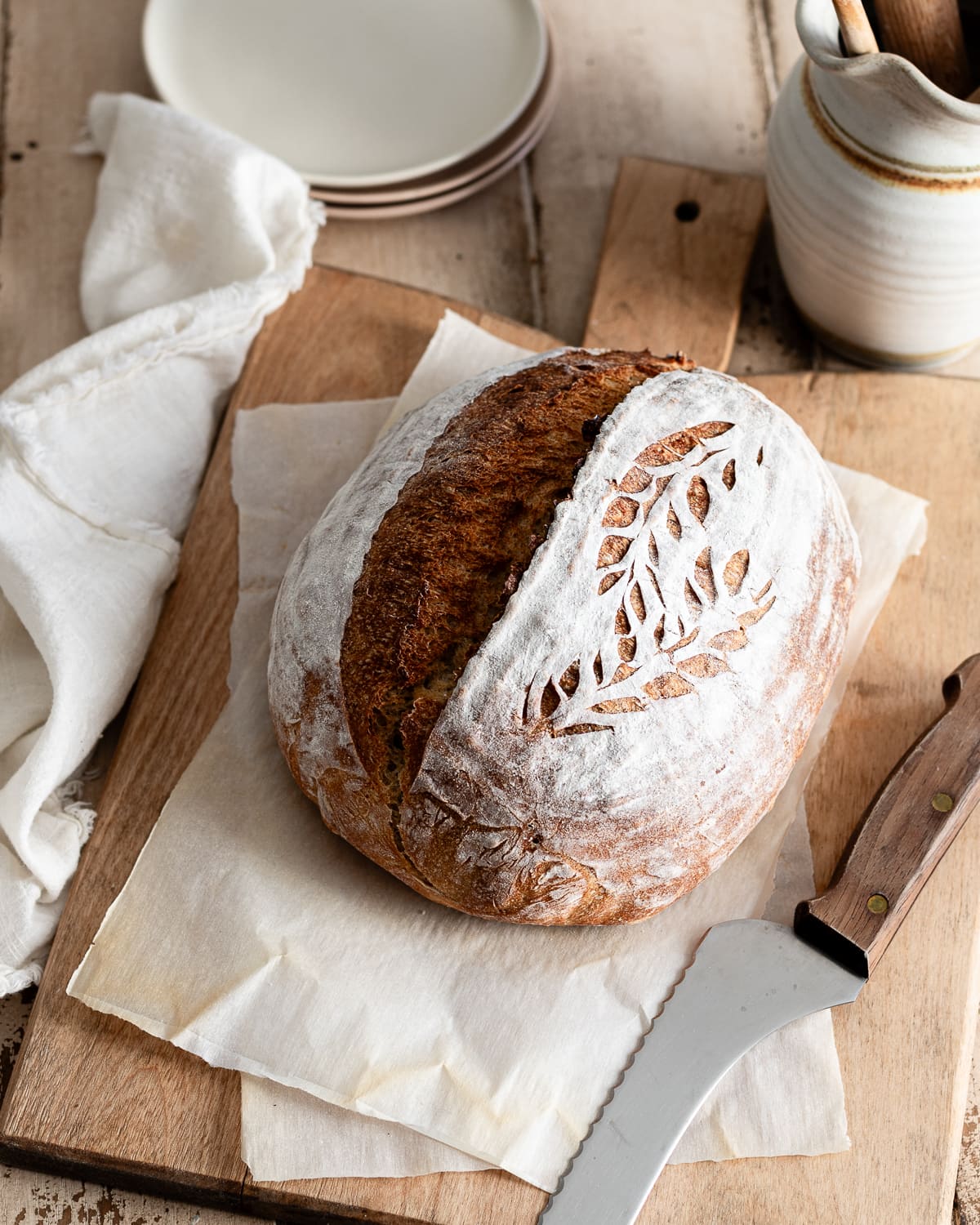
Want to learn how to create beautiful decorative scoring patterns on your bread? My sourdough bread scoring guide is a great place to start.
Did this recipe rise to the occasion?
★★★★★
Leave a star rating and a comment. Your feedback inspires future recipes and helps others feel confident choosing what to bake next. I read and respond to every message.
If you're looking for additional ways to support my work, share this recipe or buy me a Ko-fi. Every little bit helps me keep creating the recipes and guides you enjoy.
Thank you for your support!
Easy Sourdough Discard Bread Recipe
This section may contain affiliate links
Ingredients
- 7 grams active-dry yeast
- 226 grams water
- 14 grams cane sugar
- 113 grams sourdough discard
- 180 grams bread flour
- 90 grams all-purpose flour
- 60 grams whole wheat flour
- 7 grams salt
Click US Customary to view volume measurements
Instructions
- Make the dough: Mix the water, active-dry yeast, and sugar in a mixing bowl. Allow the mixture to bloom until it smells yeasty and looks bubbly.7 grams active-dry yeast, 226 grams water, 14 grams cane sugar
- Fold in the sourdough discard, bread flour, all-purpose flour, whole wheat flour and salt until no traces of dry flour remain. Cover the bowl with plastic wrap and let the dough rest for 10 minutes.113 grams sourdough discard, 180 grams bread flour, 90 grams all-purpose flour, 60 grams whole wheat flour, 7 grams salt
- Stretch and fold: After the rest period, complete 3 sets of stretch and folds in 15-minute intervals.
- To complete a stretch and fold, with the dough inside your bowl, pick up the side of the dough closest to you using your fingertips. Stretch the dough out as much as you can without it tearing and fold it over itself. Turn the bowl 90 degrees and repeat 3 more times.
- Cover the bowl with plastic wrap. Set it in a warm place and let the dough rest for 15 minutes.
- First rise: Let the dough rise at room temperature until doubled in volume. The dough should double in volume and appear bubbly, about 10 to 15 minutes.
- Prep: Preheat the oven to 475 F with a Dutch oven inside.
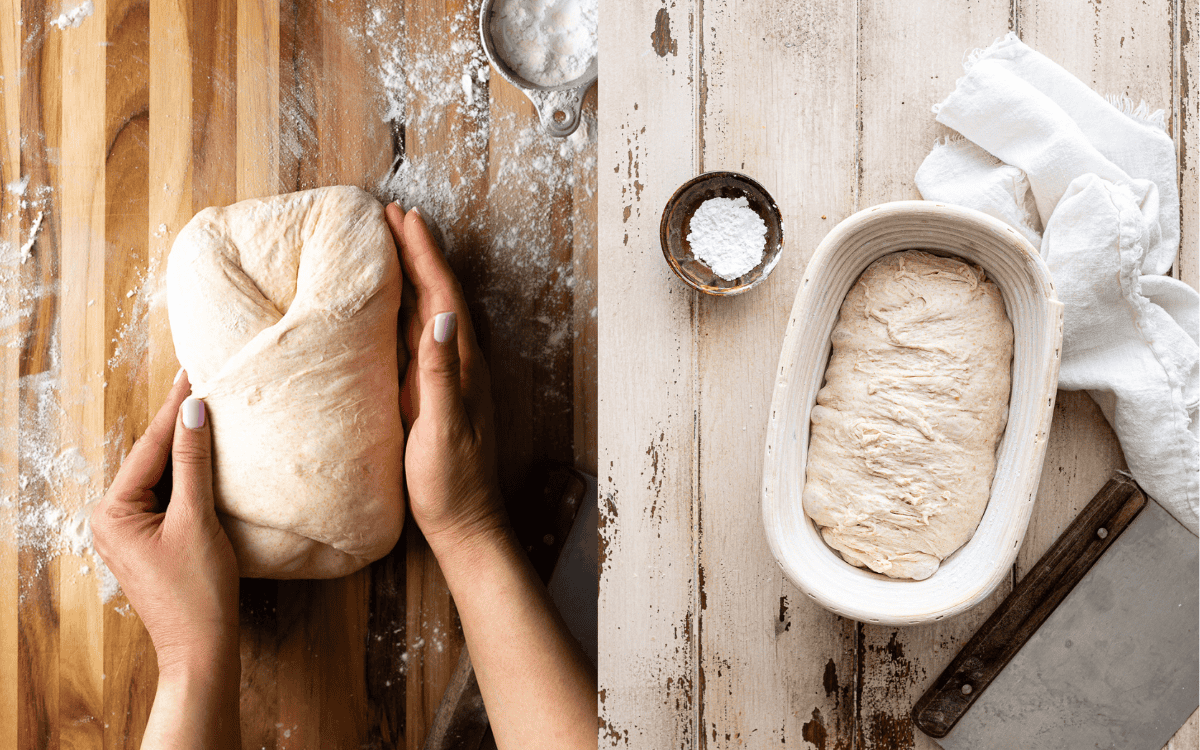
- Shape: Coat a banneton with rice flour (see note*). Shape the dough into a boule or a batard.
- To shape your dough, turn the proofed dough on a clean work surface. Flatten the dough out into a rectangle. Fold the side closest to you towards the center and the top of the dough over the bottom flap. Fold the sides over each other
- Flip the dough and round it into a boule or roll it into a batard. Place the dough into a prepared banneton with the seam side up.
- Second rise: Cover the banneton with plastic wrap and let the dough rise until puffy and well risen, about 30 to 45 minutes.
- Score: Transfer the dough to a piece of parchment paper with the seam-side down. Score the dough.
- Bake: Place the dough with the parchment paper inside the hot Dutch oven. Bake the dough covered for 25 minutes and uncovered for 10 to 15 minutes.
- Enjoy: Transfer the baked loaf to a cooling rack. Let the bread cool for at least 2 hours before slicing.
- Store: This bread will store well for up to a week in an airtight container at room temperature.
Tips
These recipes were developed and tested using grams for precise measurements. To increase your chances of success, I recommend investing in a kitchen scale. I've included rough volume estimates (in tablespoons and cups), but they might not be totally accurate.
Remember all ovens are unique, these recipes were tested in my oven which runs cooler than others. You might need to lower the temperature if your bake appears to be browning too quickly. Monitor your bake closely and make adjustments if needed.
Notes
Nutrition
I am not a nutritionist or dietitian, any nutrition information provided is an estimate.




Mariana says
At what point can I add toppings? And can I cut the dough and make 2 small loaves instead of one big one? At what point do I do this? I tried yesterday and it didn’t work. I cut the dough right before I put them in separate bannetons then I baked them and the loaves didn’t rise. Please help. I’ve tried this recipe twice and I was successful. Just want to be able to make smaller loaves too.
Hannah Dela Cruz says
Are you adding toppings on the bread or inside? Dividing the dough shouldn't be an issue here. Perhaps your kitchen was cold and they didn't have enough time to rise. Or they could have become overproofed. Dough usually takes less time to rise when they are shaped smaller.
Phoebe says
I've been baking sourdough bread weekly for about four years, and will definitely add this recipe to my collection. I used a scale and followed the recipe, adding a couple of tablespoons of seeds (sesame/sunflower/flax) during the first set of folds. The dough was wet but not any wetter than what I'm accustomed to, and the structure developed beautifully with the stretch and folds. I used the times and temperatures as given. I always put a pizza stone on the rack below my Dutch oven to prevent over-browning, and that worked perfectly here. The final internal temperature was 208 degrees. While the crust is more tender than that of my typical sourdough loaves and the crumb less open, the texture of this bread appeals to me much more than the soft "sandwich breads" so many people make with discard. Five stars!
Hannah Dela Cruz says
So glad you loved it!
Patricia says
I have tried a couple of same-day sourdough recipes with no success, but this one is the bomb. This will be my go to recipe from now on, I’m making my second loaf today. Thank you for your hard work and sharing this recipe.
Hannah Dela Cruz says
I'm so excited that this recipe worked for you and you found one that is a keeper!
Carmen says
This is not a repeater recipe for me. I followed it to a T, and made a sad, flat little loaf. The flavor is good, but the height and crumb are not great. 😞
Hannah Dela Cruz says
Hi so sorry you had a bad experience. Did your dough rise? It's a bit cold in most places right now so maybe your yeast was just a tiny bit sluggish.
Kimberly says
This is my first attempt with the sourdough starter that a dear friend gave to me. I accidentally made ALOT and found this recipe when I searched for "what to do with sourdough discard". It was a wonderful place for a brand new sourdough baker to start. I was able to go through all the steps, only quickly, and see how it all comes together. My loaf looks beautiful already and is in its final 15 minutes of baking. I can't wait to let it rest and have it with our soup for dinner! Thank you for a great recipe!!
Hannah Dela Cruz says
Welcome to the wonderful world of sourdough, Kimberly! Glad you were able to find this recipe. The steps you completed to bake this loaf are very similar to the ones needed to make a loaf of sourdough bread so this should help when you're ready to make your first loaf. Excited to have you on the sourdough journey.
Josie says
I did use a stand mixer to get it all mixed up, just easier to me as I made two loafs at once. Still stretched it the same. I used honey instead of sugar, same amount of grams the recipe asks for. I don’t have a Dutch oven so I used glass loaf pans, buttered. It made tasty and perfect sandwich bread! I’m new to sourdough, first time making bread with my discard while my starter is getting ready. I really haven’t been making bread long in general but this was super easy to follow and the taste is perfect! I did lower my temp about 3/4 of the way to 425 and after ~25 mins they were nicely browned and looked done so I pulled them out. I let them cool a little in the pan before removing to the rack. 10/10 would recommend this recipe. Thank you!
Steph says
Followed recipe exactly and bread was delicious thank you! Will be using again !
Cheryl says
Wondering if 475 is too high for baking this bread. I just took my loaf out of the oven, haven't sliced it yet. It burned on the bottom, also the parchment paper is burnt & sticking to the bottom. I'm tearing it off in little pieces.
Hannah Dela Cruz says
Every oven has its own quirks. Mine tends to be a little cooler than others, so 475 F may be too hot for your oven.
Thanks for your feedback!
Cheryl says
The bread was delicious! Its definately a keeper! Will try 375 next time. Would have given 5 stars if the instructions were clear about waiting 15 minutes between stretch & folds. Can`t wait to try more of your recipes!
Allison says
This was my first run through with this recipe and it turned out amazing!
I was a little nervous working with a higher hydration dough but using the tips outlined (wetting fingertips before stretch and folds) and only handling the edges of the dough, it turned out just fine. I love that this loaf yields a similar structure to a true sourdough loaf with a fraction of the time and effort. Will definitely make again.
Micala says
My dough seems super wet and sticky, so I'm allowing for additional folds.. I'm super new to bread-making, so I'm not sure if this is appropriate? The dough was too wet to properly stretch/fold. Help?
Hannah Dela Cruz says
Hi Micala! It's totally normal for dough to feel wet and sticky if you're not used to handling such high hydration doughs. Be patient and be more gently than you think you need to be. Doing more folds could actually break the gluten bonds, not allowing them to relax and reform.
Dawn says
Cami make additions in the last step? I make sourdough usually, but want to take a loaf to a friend today and wold like to add add jalapeños and cheddar
Hannah Dela Cruz says
Hi Dawn! I would fold your fillings in during the second fold. You can follow my process from my Date and Pecan Sourdough. Just sub cheese and peppers and follow the timeline for the discard bread. Hope that makes sense. If it doesn't shoot me an email!
https://makeitdough.com/date-and-pecan-sourdough-bread/
CJ says
This as difficult due to not having standard measurements of cups, tablespoons, etc.It is frustrating to have to convert everything.
Hannah Dela Cruz says
Hi CJ! Just added the volume measurements for this recipe. I must have missed it the first time. Hopefully you try the recipe again.
Ash says
Measuring in cups is not “standard” anywhere in the world except for the USA.
monique says
I only have quick rise instant yeast is that ok? thanks again..
Hannah Dela Cruz says
Yes!
monique says
I don't have whole wheat flour can I just use all purpose and bread flour? if so what would the measurements be. thanks:)
Hannah Dela Cruz says
You can substitute all-purpose for the whole wheat flour in a 1:1 ratio.
Amani says
Came out perfect. crusty and not to chewy.
paula says
For the first rise, is 10-15 min really enough time to double? Just checking ◡̈
Hannah Dela Cruz says
Hi Paula - according to the instructions you need to do 3 sets of stretch and folds in 15 minute increments this takes 45 minutes. After the last fold you let the dough rest for another 15 minutes. In total your dough has been fermenting or "rising" for an hour. So yes, after the rest period your dough should look well risen.
Cheryl says
The instructions aren't clear about doing stretch & folds in 15 minute increments. I did all of them at the same time. I sent your recipe to my Grand Daughter & I know she'll be confused about that part also.
Hannah Dela Cruz says
Thanks for your feedback! Fortunately, that shouldn't adversely affect your bread. But I appreciate your notes! I will add more detail to the post.