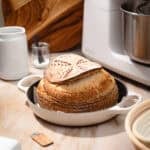
Spiral Mixer Sourdough Recipe
My method for making sourdough bread in a spiral mixer. It’s a mostly hands-off process that has made sourdough baking much easier to fit into my week. Your mixer, time and fermentation do most of the work and the result is still a delicious well-risen loaf with a creamy crumb and delicate crisp crust.
Servings: 10 slices
Calories: 176kcal
Equipment
- Bread Pan
Ingredients
Initial mix
- 200 g all-purpose flour
- 200 g bread flour
- 60 g whole wheat flour
- 113 g active sourdough starter
- 226 g water
Second Mix
- 56 g water
Final mix
- 9 g salt
- 56 g water see note
Instructions
Mix the dough
- Mix the flour, starter and 226 grams of water on low speed until a shaggy dough forms.200 g all-purpose flour, 200 g bread flour, 60 g whole wheat flour, 113 g active sourdough starter, 226 g water
- Once the dough reaches the “pumpkin stage,” slowly stream 56 grams of water around the outside of the dough. Continue mixing on medium-low speed for 5 minutes.56 g water
- Let the dough rest in the mixing bowl for 30 minutes.
- Turn the mixer to low speed and add the salt.9 g salt
- Mix the dough for 10 minutes total, gradually increasing the speed to medium.
- While mixing, slowly stream the remaining 56 grams of water around the edges of the dough.56 g water
Bulk ferment the dough
- Round the dough into a tight ball and transfer it to a clean lightly-oiled bowl.
- Cover the bowl with plastic wrap and let the dough ferment in a warm area for 4 to 6 hours or until it has noticeably increased in volume.
Shape the dough
- Turn the dough out onto a clean work surface. Using your finger tips, gently pick it up from the center and lift until the ends pull away from the surface. Tuck the ends underneath the dough, cover with a tea towel and let it rest for 30 minutes.
- After the rest period, shape the dough into a batard or boule and transfer to a proofing basket.
- Refrigerate the dough overnight
- Cover your proofing basket with plastic wrap and store it in the refrigerator overnight, 8 to 16 hours.
Prep for baking
- Place your bread baker or cast iron pot in the oven. Preheat to 450 F.
Score the dough
- Take the dough out of the refrigerator and transfer to a piece of parchment paper.
- Score the dough using a lame fitted with a sharp blade.
Bake the dough
- Transfer the dough with the parchment paper into your preheated bread baker.
- Bake with the lid on for 30 minutes.
- Remove the lid and bake for an additional 15 to 20 minutes or until the bread reaches your desired level of brownness.
Enjoy and store
- Transfer the baked loaf to a wire rack and let the bread cool completely, at least two hours, before slicing.
- Store any leftover slices in an airtight container at room temperature for up to 1 week.
Notes
- Make sure your starter is active before starting this recipe.
- If you don’t have the other types of flour on hand, you can use all bread flour or all-purpose flour instead.
- Use cool water instead of warm water, the mixing process warms the dough up and too much heat can interfere with gluten development.
- I provide time guidelines for fermentation, but if your dough needs more time to rise, let it ferment longer. Always use the appearance of the dough rather than the clock to determine when it’s ready.
- This recipe is about 76% hydration. If you’re not comfortable working with high-hydration dough, feel free to leave out the final 56 grams (¼ cup) of water added during the last mix.
Nutrition
Calories: 176kcal | Carbohydrates: 36g | Protein: 6g | Fat: 1g | Saturated Fat: 0.1g | Polyunsaturated Fat: 0.3g | Monounsaturated Fat: 0.1g | Sodium: 352mg | Potassium: 63mg | Fiber: 2g | Sugar: 0.1g | Vitamin A: 1IU | Calcium: 9mg | Iron: 1mg