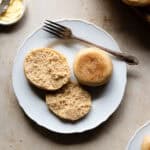
Sourdough Discard English Muffin Recipe
Don't toss your sourdough discard! Give your breakfast routine a delicious upgrade by transforming leftover sourdough starter into these flavorful Sourdough Discard English Muffins.
Servings: 16 English muffins
Calories: 141kcal
Ingredients
Dough
- 340 grams water
- 7 grams active-dry yeast
- 14 grams brown sugar sub honey or maple syrup
- 60 grams whole wheat flour
- 450 grams bread flour
- 10 grams salt
- 113 grams sourdough discard
- 28 grams unsalted butter softened
Topping
- 14 grams cornmeal sub cream of wheat
Instructions
- Bloom the yeast: Whisk the water, brown sugar and yeast together in a large mixing bowl. Cover the bowl and let the yeast bloom until foamy, about 15 minutes.340 grams water, 7 grams active-dry yeast, 14 grams brown sugar
- Make the dough: Using a stiff spatula or a wooden spoon, stir the remaining dough ingredients into the yeast mixture until no dry bits of flour remain. Switch to your hands and knead until a cohesive dough forms.60 grams whole wheat flour, 450 grams bread flour, 10 grams salt, 113 grams sourdough discard
- Knead the butter into the dough until completely absorbed. The dough should start greasy and gradually become smoother and less sticky.28 grams unsalted butter
- Stretch and fold the dough: Pull one side of the dough up as far as it will stretch, then fold it over itself. Turn the bowl 90 degrees and repeat until all 4 sides of the dough are folded and the dough looks smooth. Round the dough into a tight ball.
- Bulk fermentation: Transfer the dough to a clean, lightly oiled bowl. Cover the bowl with plastic wrap and set it in a warm place until doubled in volume, about 30 to 45 minutes.
- Prep: Line two large baking sheets (18 by 13-inch) with parchment paper. Dust the baking sheets with cornmeal or cream of wheat. Set aside.14 grams cornmeal
- Shape the dough: Turn the dough out onto a lightly floured work surface. Using a rolling pin, flatten the dough out to a 12 by 10-inch rectangle, about ½-inch thick. Using a 3-inch biscuit cutter, cut as many rounds as you can out of the dough. Place the dough rounds on the prepared baking sheet, be sure to leave about 2 inches of space between each dough round on the prepared baking sheet. This prevents them from sticking together
- Re-roll the dough: Gather the dough up into a ball and knead until it comes together into a smooth ball. Cover the dough with plastic wrap and let it rest for 15 minutes, this will make it easier to roll out.
- Flatten the dough out into a 10 by 6-inch rectangle, about ½-inch thick. Cut out as many rounds of dough as you can. Re-roll scraps once more. I ended up with 16 rounds. Place the rounds on the prepared baking sheet.
- Final Proof: Let the dough rise until puffy and well-risen, about 15 to 20 minutes.
- Prep: While the dough rises, preheat a dry skillet over medium-high heat. Preheat the oven to 350 F.
- Griddle the English muffins: Lower the heat to medium-low and gently transfer 3 portions of dough to the preheated skillet. Be very gentle and avoid flattening or stretching them. Fry the dough, untouched for 6 to 8 minutes or until one side is golden brown. Flip the dough and continue frying for another 6 to 8 minutes.
- Bake the muffins: Transfer the cooked English muffins back to the prepared baking sheets. Bake for 10 minutes. This will dry out the interior and ensure the crumb is no longer gummy and raw. Transfer to a wire rack and let the muffins cool for 10 to 15 minutes.
- Finish the English muffins in the toaster: Using a fork, poke holes into the side and pry the sides apart. Toast the muffins until heated through and some spots are lightly browned. Top with your favorite spreads and enjoy!
- Store: Split up the English muffins, and wrap in plastic wrap. Store wrapped English muffins in an airtight container and store in the freezer for up to 1 month. Toast the English muffins without defrosting
Notes
- Make sure your yeast is not expired before baking these rolls or your dough may not rise.
- Give your dough enough time to rise, waiting until it has doubled in volume before shaping. Otherwise, your bread may be dense and gummy.
- Feel free to use active sourdough starter or sourdough discard to make this recipe.
- Both instant yeast and active dry yeast will work to make this recipe.
- Don’t skip toasting! English muffins are not fully baked after they come out of the oven. Toasting ensures the interior reaches a safe final temperature and achieves a desirable texture.
Nutrition
Calories: 141kcal | Carbohydrates: 26g | Protein: 4g | Fat: 2g | Saturated Fat: 1g | Polyunsaturated Fat: 0.3g | Monounsaturated Fat: 0.5g | Trans Fat: 0.1g | Cholesterol: 4mg | Sodium: 245mg | Potassium: 50mg | Fiber: 1g | Sugar: 1g | Vitamin A: 45IU | Vitamin C: 0.001mg | Calcium: 8mg | Iron: 0.4mg